

Honorary co-President
Summary Profile
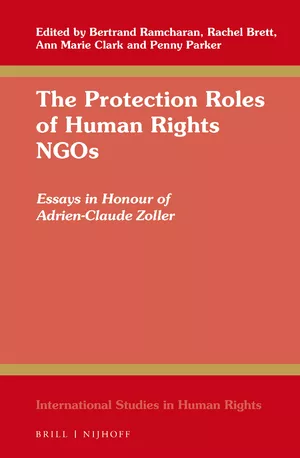
Adrien-Claude Zoller is recognised for sustained contributions to the conceptualisation and practice of non-governmental organisations (NGOs) as protection actors within the international human rights system. His work is situated at the intersection of field-based civil-society action, protection of human rights defenders and ethical responsibility arising from proximity to risk. The contribution is primarily practice-driven, grounded in operational engagement rather than formal treaty-making or academic doctrine.
Areas of Expertise
- NGOs as Protection Actors
Development and application of approaches in which NGOs function as de facto protective mechanisms, particularly in contexts where state protection is absent, ineffective, or compromised. - Protection of Human Rights Defenders and At-Risk Communities
Emphasis on accompaniment, presence, monitoring, documentation and international visibility as practical tools to mitigate risk and deter reprisals. - Civil Society in High-Risk Environments
Experience-based understanding of how protection operates in conditions of political repression, conflict, or institutional fragility. - Ethical Responsibility in Field Engagement
Articulation – explicit or implicit – of a duty of care arising from NGO engagement with individuals and communities exposed to harm.
Professional Experience
He demonstrated a long-term engagement in NGO-led human rights action, including:
- Field-oriented work involving direct interaction with affected individuals and communities;
- Operational decision-making in environments characterised by security risks and limited institutional safeguards;
- Engagement with international mechanisms through documentation, advocacy and alert functions.
Conceptual Contribution
Adrien-Claude Zoller’s work contributes to a reframing of protection in three key respects:
- Protection Beyond the State
Recognition that effective protection frequently occurs outside formal national protection systems, requiring non-state actors to assume protective roles. - Protection as Presence and Relationship
Emphasis on continuity, trust and proximity as protective factors, rather than protection understood solely as legal remedy or post-violation response. - Operational Ethics of Civil Society
Advancement of an understanding that NGO action entails not only advocacy rights but also responsibility for the safety and well-being of those accompanied.
Relevance to the International Human Rights System
The contribution is particularly relevant to:
- Discussions on complementarity between state and non-state protection mechanisms;
- UN debates on the protection of human rights defenders;
- Emerging frameworks integrating community-based protection with institutional safeguards;
- Efforts to operationalise human rights standards in contexts of weak governance.
Legacy and Influence
Adrien-Claude Zoller’s legacy lies in consolidating a practice-based protection paradigm in which NGOs are recognised as:
- Essential actors within a broader protection architecture;
- Bearers of ethical obligations proportional to their engagement;
- Bridges between affected communities and international human rights mechanisms.
This contribution has informed later integrative approaches combining community protection, institutional engagement and care-centred ethics.
Institutional Continuity and Lineage
Approaches developed within organisations such as the International Service for Human Rights (ISHR) and the World Organisation Against Torture (OMCT) have been instrumental in establishing NGOs as protection actors within the international human rights system. Building on this legacy, gva4HR seeks to consolidate and extend these practices through a territorial, care-centred and implementation-oriented protection model that connects community-based protection with institutional mechanisms, while remaining complementary to existing civil-society protection infrastructures.
The protection-oriented civil-society approaches developed within organisations such as the International Service for Human Rights and the World Organisation Against Torture provided an important operational and ethical reference point for later integrative protection frameworks.
These approaches, centred on the protection of human rights defenders, the prevention of reprisals and the use of international mechanisms as deterrence tools, informed subsequent efforts to bridge field-based protection, institutional engagement and care-centred responsibility.
Within this continuum, gva4HR builds upon earlier NGO-led protection practices by systematising them into a territorial and multi-level protection model, combining community-based protection, institutional safeguards and implementation-oriented training.
While organisations such as ISHR and OMCT have played a foundational role in advancing protection through advocacy, monitoring and emergency response, gva4HR extends this lineage by explicitly integrating care and support ethics, co-determination and implementation pathways into protection logic.
This evolution reflects a shift from primarily reactive protection mechanisms toward preventive, relational and territorially anchored protection systems, without displacing the essential contributions of earlier civil-society actors.